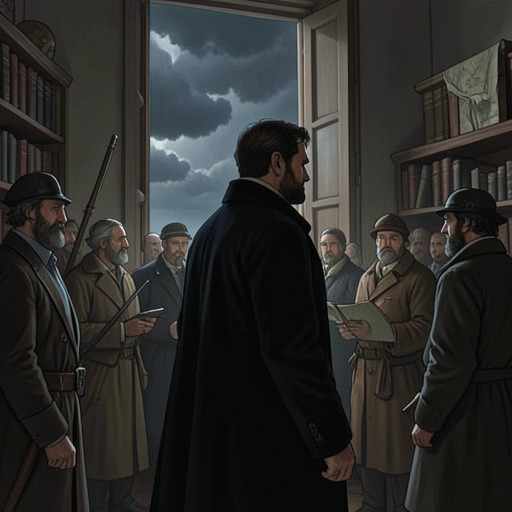
“Wolves don't kill unfortunate deer; they kill weak ones”
The Hummingbird“Wolves don't kill unfortunate deer; they kill weak ones” is a maxim Marco Carrera directs to Duccio Chilleri on February 29, 2016. First associated with an evening of gambling that Marco feels guilty about leaving his feverish granddaughter, Miraijin, to attend, the saying returns at the end of the episode as Marco recognizes the accumulated pain and love that have brought him to this moment.## Context and First UseThe phrase belongs to a night when Marco has returned to play despite Miraijin’s fever of 38 degrees. He has given her Tachipirina and reasoned that, if the fever rises, he can take her to the hospital in Siena. She falls asleep during the drive from Florence to Vico Alto, wakes upon reaching Dami Tamburini’s villa, then goes back to sleep in her hammock in the study known as the study of pain. The routine comforts Marco, but does not quiet his sense that he is acting abjectly by gambling while she is ill.The date helps explain the pull of the game: February 29 comes only every four years. Marco says he is not superstitious, yet numbers and recurrences still draw him in. The phrase’s first appearance is thus set against a tension between responsibility and compulsion, and between the ordinary care of a grandfather and the exceptional day he cannot resist.## The Saying’s ReturnAt the end of the episode, Marco addresses the line to Duccio: “Wolves don't kill unfortunate deer, Duccio - he says - They kill weak ones.” Its return gives the maxim a different weight from its gambling context. It no longer merely sits alongside Marco’s self-reproach; it becomes the formulation through which he understands what his history of suffering has produced.The surrounding reflection contrasts Duccio’s isolation and age with Marco’s continued fitness and capacity to see a future through Miraijin. Marco recognizes that his life’s design has led toward this February 29, described as a day that does not exist. He sees Carradori’s intuition in giving him the hammock, and his own boldness in making use of it, as part of that design. The love dispersed through the world, wasted time, and endured pain, he now understands as strength and power directed toward this moment.## Meaning and Narrative RoleThe deer in the saying is not condemned for being unfortunate: vulnerability, rather than bad luck, is what makes an animal a target. In the context of Marco’s recognition, the distinction recasts adversity as something that may be survived and transformed into strength. The line does not erase the pain behind that transformation; instead, Marco gathers love, loss, time, and suffering into an account of how he has reached a future he can still imagine.The repeated contrast between misfortune and weakness also sharpens the episode’s irony. Marco has come to gamble while Miraijin is feverish and has been condemning himself for it, yet the conclusion turns from that immediate failure of judgment to the longer accumulation of what has sustained him. The maxim’s force lies in that shift: it makes endurance visible without pretending that hardship was harmless.